This is a lengthy interview with Uwanosora ’67 about their album Portrait in Rock’n’Roll 2.
Very enlightening and in-depth, this discussion is a real treasure for fans of the band. I was going to include a disclaimer warning you against reading it all in one go (the word count is over 10,000!), but hey, there are worse ways to go than overdosing on Uwanosora.
Interview & photography: Sugano Keisuke (Japanese text, additional photography from Uwanosora’s social media)
English translation: Henkka
Uwanosora: Linktree
Note: You can buy Portrait in Rock’n’Roll 2 on CDJapan.
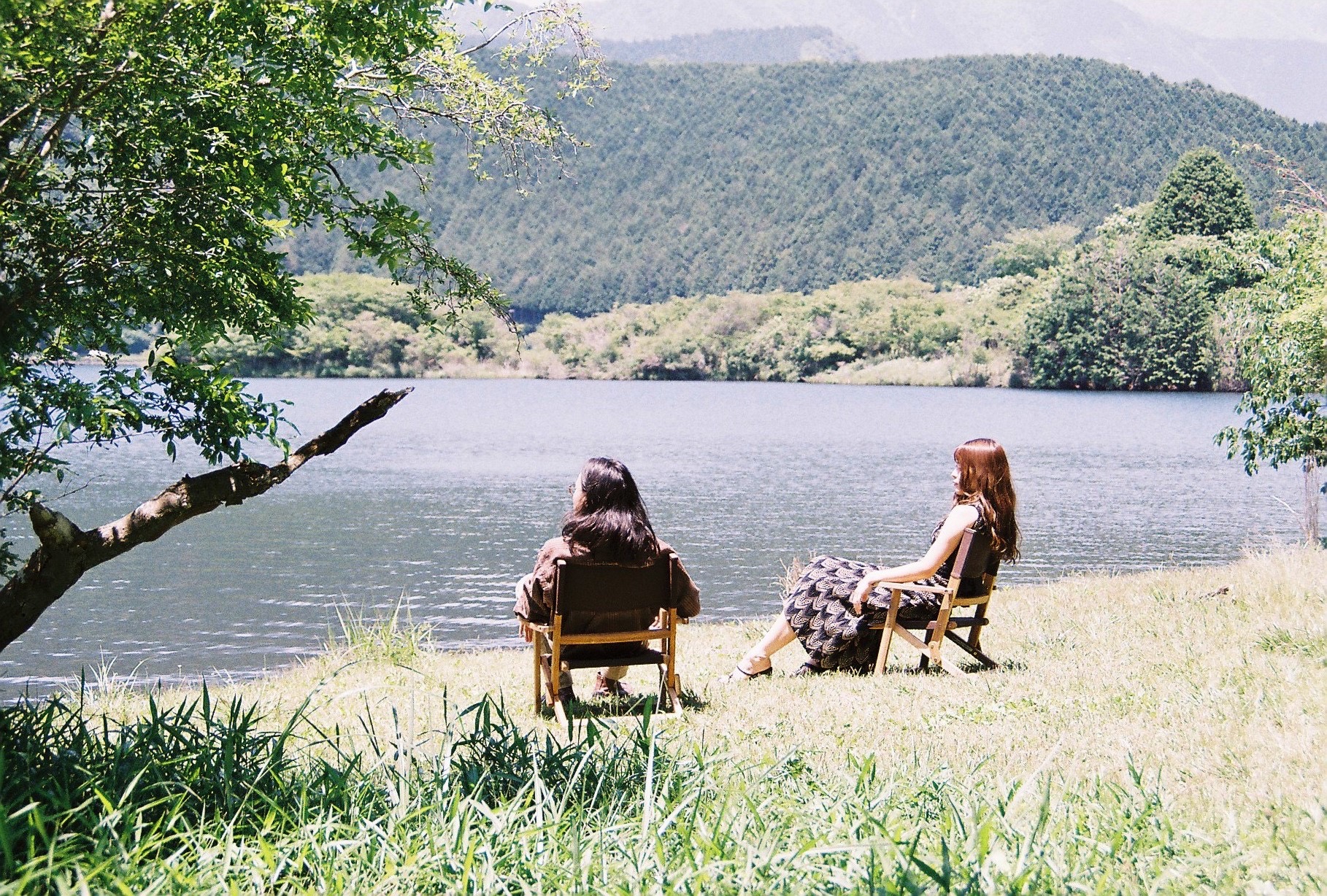
What follows is an interview conducted on 2 August 2022 with Iemoto Megumi and Kadoya Hirohide of Uwanosora ’67, commemorating the release of their album, Portrait in Rock’n’Roll 2. It is the first release by Uwanosora ’67 since 2015’s Portrait in Rock’n’Roll.
In their work, Uwanosora/Uwanosora ’67 have tirelessly continued to pursue their musical desires. The first half of the interview is a conversation with Kadoya, and the second half with both Kadoya and Iemoto. We would be glad if this interview could help you understand even in some small way what this new album is all about, and what these two are like as people.
— I look forward to speaking with you today.
Kadoya Hirohide: Likewise. I think it might be our first face-to-face interview.
— First, congratulations on the release.
Kadoya: Thank you. It’s our first album since 2019’s Yogiri, and overall our first release since the maxi-single Kurage from 2020 and the Heart no Tekagami/Mujuuryoku no Photographer 7-inch that we put out in the fall of 2021.
— Could I ask you to explain once more the difference between the “unlabeled” Uwanosora and Uwanosora ’67?
Kadoya: Originally, Uwanosora ’67 came about after we’d put out our first album as the “unlabeled” Uwanosora. At the time, me and Oketa were talking about how we wanted to make an album that emphasized the ’60s.
But then because we both had different ideas about the direction—as in how we wanted to make it and what it should sound like—we decided to do separate projects. I was going to release mine as Uwanosora ’67, and Oketa was going to do his project, also featuring Iemoto on main vocals. So then after I released my album (Portrait in Rock’n’Roll, 2015), Oketa released an album called Teiyuu Mokuroku (2017) under his own name, and then he left the band after that.
So in short: “Uwanosora” was the three of us, and “Uwanosora ’67” was only me and Iemoto. But then it ultimately ended up being just me and her in both projects… That is to say, it wasn’t our intention for that to happen—it’s just what ended up happening.
Basically, Uwanosora is fusion, 16-beat, a bit of jazz… It sounds more mid-’70s and later; more technical and polished. But this time around, we wanted to make an album that sounded more like the first ’67 record, and to have it draw on the qualities of that whole era. It didn’t really matter which name we were going to release it as—we just decided to go for ’67.
— I see. By the way, speaking about the album title (Portrait in Rock’n’Roll 2), the “2” gives the impression that it might be a sequel. But when you actually listen to it, it doesn’t necessarily feel like one…
Kadoya: At its core it was supposed to be a continuation, but we weren’t particularly conscious about actually making it that way while working on it.
— Got it. Just to backtrack a bit… Since your debut album, you’ve also changed your base of operations, right? Around the time of your first album you were in Kansai, whereas now you’re in the Kanto area—although I’m sure you must’ve changed locations many times even in the interim. I was just wondering, in terms of songwriting or otherwise, does your environment affect the songwriting in any way?
Kadoya: During the making of the first ’67 album, I was living behind the university, and so I would go in there in the middle of the night to record, or I could go to my friend’s (Fukamachi) house and we’d work on arrangements together—I could be really quick on my feet.
But gradually, everyone got busy with their lives and there started to be more distance between people… So on this album, I got Fukamachi to record his backing vocals and to help with the arrangements remotely. That kind of thing. Even with people like our mixing engineer Tamada, up until Hidamari I was always there with him in-person…
— You would go to Osaka to do so?
Kadoya: Right, to Osaka. I was living in Izu around the time we were making Hidamari. I would crash at a friend’s place so I could be there for the mixing, but then I became friends with other people who’d come over, and I’d end up crashing at their places, too…
In repeating that process, I suddenly had a lot more places available for me to stay at. So then as I became friends with more and more people, I finally ended up befriending someone who lived right next to the train station nearest to Tamada’s home studio—it was within walking distance. (laughs)
— Seeing as you formed Uwanosora in your student days, many of the musicians playing for you were people you’d met through university. So then what with you having moved locations and thus no longer being able to meet with those people as easily anymore, did that change anything?
Kadoya: Right now, I think it’s actually about 50% musicians we met through university and 50% musicians who we met through our activities as Uwanosora.
With this being our fifth full-length album, even if there is now distance between us, everyone pretty much already knows what it is we’re trying to do, and I feel like especially this time around we were able to really bounce ideas off each other to get the sound I was going for. Especially on the sound production and recording side of things, me and Tamada had multiple discussions about it which meant that that part of it wasn’t very difficult.
— When you’ve been doing it for as long as you have…
Kadoya: Right. If anything, after the work was done, we all felt sad about not having the time to just have some drinks and talk about the music.
— Ah, I see.
Kadoya: Especially considering how it was such an extended, years-long process, I feel like we didn’t have a lot opportunities to unwind, or like, just talk casually like we used to do between classes.
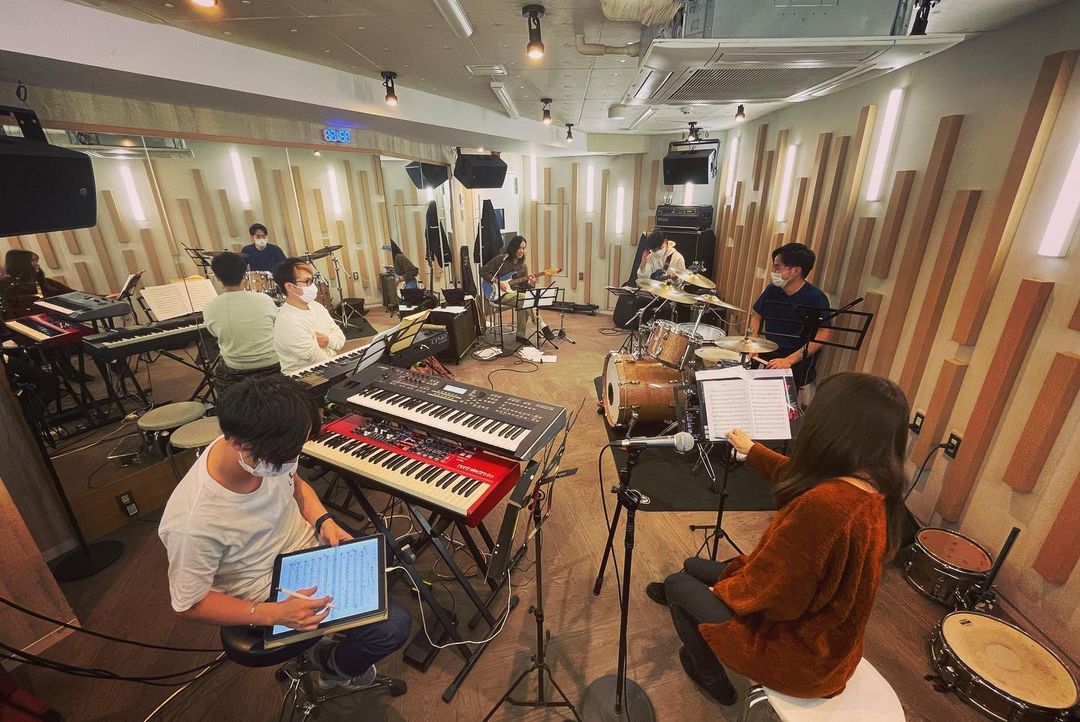
— You just kind of touched on this, but how long did the whole production process take you this time around?
Kadoya: We started around October 2020. Well, I was already thinking I wanted to make this album as early as August, but it was really around the second half of September that I set out to do it.
— I would think that by that time COVID was already in full swing. This might be a bit of a broad question, but how did you spend your time during the pandemic?
Kadoya: The pandemic started right around the time we were working on Kaede’s mini-album, but I didn’t really meet with a lot of people during that process—I need a lot of alone time in order to think, and I’m usually pretty much a stay-at-home kind of person anyway, so it didn’t really affect me. Only for Kaede’s song “Farewell Is A Heartwork,” the sax and flute recordings by Ando (MELRAW) happened to coincide with the state of emergency, so we had to do that remotely.
…Ah, although I now remember walking along this riverbank one day, and people were giving me these mean looks, trying to avoid me as I was walking past them. Actually, I remember someone specifically opening up their umbrella just to guard themself from me. That hurt. It was like, “What am I, a virus?!”
— So it didn’t really affect your daily life all that much.
Kadoya: Honestly, not really.
— To get back on topic: the production began in around October 2020, and lasted until… when in 2022 was it?
Kadoya: Around 10 July 2022.
— So a little under two years. Is that short or long, compared to your past releases?
Kadoya: Pretty much the same, more or less.
— I’d like to know more specifically how that time was allotted. Writing lyrics, composing, recording, arranging, mixing—there’s many steps to the whole process, so I’m wondering: which part of it takes you the longest?
Kadoya: It has to be the songwriting. It takes me at least a month to do the basic track and lyrics for one song, even when I’m working my absolute hardest.
— Is that because of your particular approach to songwriting?
Kadoya: I think so, yeah. For some people it can take even longer, while other people can write a good song in just minutes… But for me, that pace is the best I can do. Mixing, too—if there’s ten songs to mix and I’m working eight hours a day, it’s going to take me around 30 days to finish.
— To ask a bit more about this specific release… In a previous interview from when you were releasing a new single, you were saying how, instead of trying to make it “conceptual,” you enjoyed the freedom of just making it “a mix of everything.” But obviously since it is an album this time, does that mean you had a concept for it?
Kadoya: In terms of things like the sound and the mixing and those sorts of audio-related aspects, yes, there was a concept.
We’re so clearly now in the streaming era, with singles and EP’s becoming the main formats, that we’re going to have to start catering to that audience if we want to survive. But I just wanted to try out one last concept like this; to make a full-length album in this style. We’d even decided what the text on the obi blurb for this album was going to say: “With gratitude to all summers.” That’s the sort of thing I wanted to make—a summer album.
— That’s interesting that you’d already decided on the obi text beforehand. Had that ever happened before?
Kadoya: No, not at all. It was a first for us. I mean, “With gratitude to all summers“… It’s a bit cringy, isn’t it? (laughs) It’s a bit cringy, but it’s also a bit emotional, like it represents the whole thing. Summers were summers even during the pandemic, and we wanted to acknowledge the summers of that era as well, trying to be positive towards life; towards all of it. Sure, there are sad songs, too, but we wanted to express that whole idea—sadness and all.
Also, all summers have a beginning and an end. It’s like with the keys on the piano or with the guitar—all the sounds have an ending. I find that sort of thing beautiful in this aesthetic sort of way. Like, how even eternity isn’t truly eternal. So maybe there’s that sort of aestheticism to the music, although that’s not limited to just this album. Things like “transience” and “imperfection”—those were the sorts of themes we were trying to really cherish on this album.
— Also, you saying this will be your “last full album“—what do you mean by that?
Kadoya: To cut a long story short… It requires such an enormous budget to make ten songs in one go. Our supporting musicians are all getting older which means we have to pay them more, and yet, people are buying less and less CDs with each passing year. That makes it extremely difficult to make an album. I mean, at least when you’re independent like we are.
Another thing is that in the ’60s it was actually the opposite—it was the “singles era.” Now it’s all about singles again, and with just the sheer amount of content that’s out there, you have to think about the turnover rate; about how often you can manage to release something. So in terms of both the type of music we do and how we sell it, we’re not conforming to the times at all—it’s no wonder we’re struggling to make new stuff. That’s why we’re going to have to start getting with the program at least in some way. Because if we don’t, we won’t be able to keep making music.
And so doing it this way—using all live instrumentation and so on—this might be the last time we’re doing that. Next time, it could be all programmed instead. What I’m saying is that it’s very difficult if you don’t try and fit in with these broader trends, at least to some extent. But then it’s also interesting in a way. It feels like that’s kind of the process through which the overall “sound of an era” is formed. Or, I mean, after you first take out all the big names, the trending artists, the acts with huge financial backing, the bands… You have to take out quite a lot. (laughs)
— When you say you might change your production methods, is it mostly because of the aforementioned financial reasons? Or is it that you’ve actually become more interested in that sort of sound as well?
Kadoya: There’s the financial aspect, sure, but I’d also say that my interests have changed—I don’t think you could really do something if you didn’t have an interest in it.
When you’re just putting out a single track or an EP, there’s none of the neurotic worrying of like, “What if it’s a total flop and we’ve just wasted all this money?” I now feel like it’s okay even if we’re more carefree and casual making music with Uwanosora. I don’t want to do another project that makes me feel like I’m about to have a nervous breakdown.
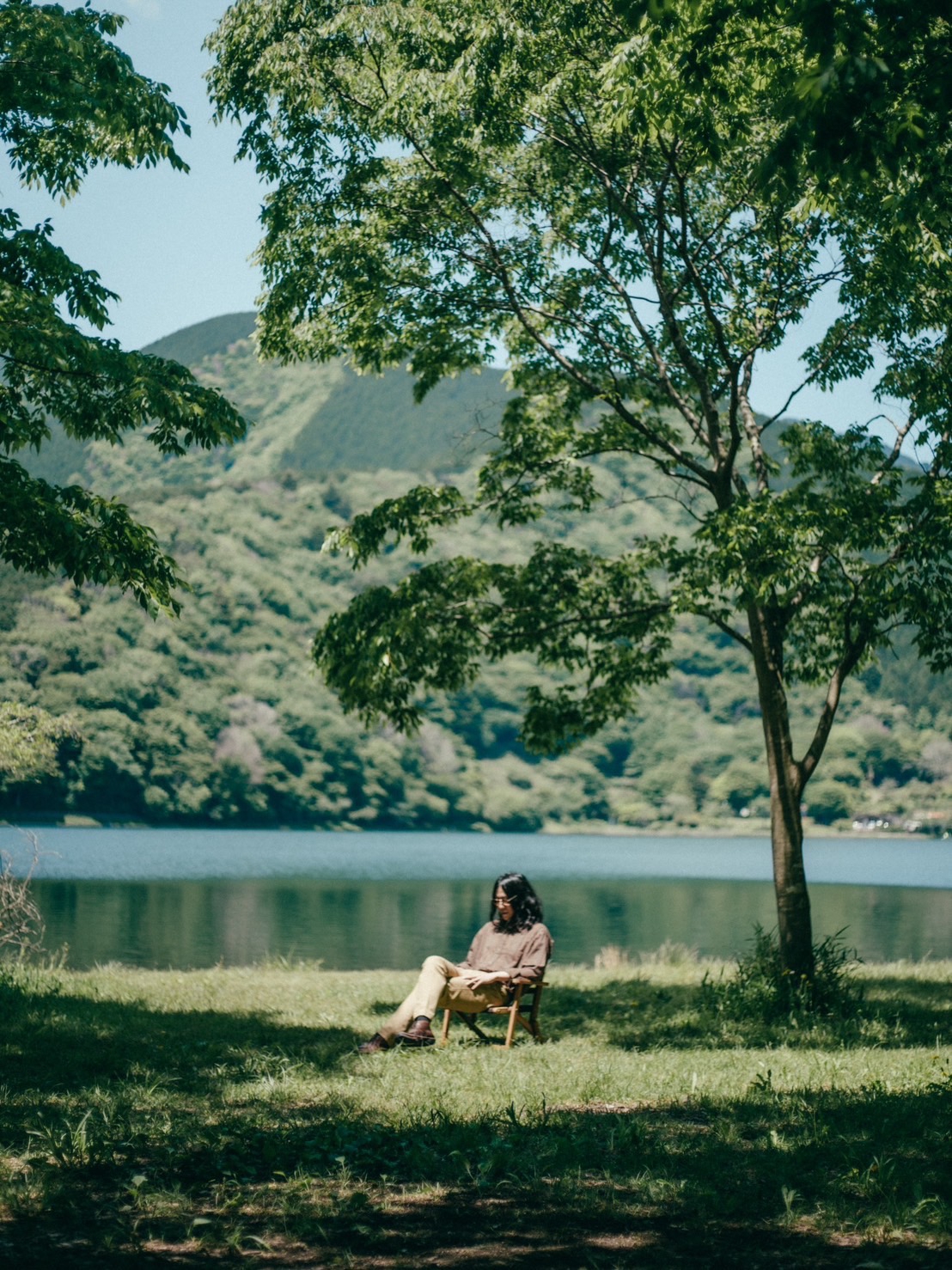
— To get back to this release, one thing that I immediately thought was different about it compared to your past releases is how much you’re singing on it. Is there a reason for this?
Kadoya: One aspect of it is that there are less songs from a female point of view—in short, it’s just a question of what’s the best way to express the world of the lyrics.
I wanted us to create sounds together that no one’s heard before, and because the human voice is where originality shines through the most, I was perhaps subconsciously trying to see what change it would bring to our music when we took parts that had previously been mainly sung by Iemoto and added a male voice.
— In the pamphlet sold at your previous show, you talked about how singing is one talent you don’t have. Were you already thinking you would be singing these songs yourself as you were writing them, or was that decision made later? In what order did it happen?
Kadoya: The lyrics to “Last Dance wa Boku to” and “Mirai Seiki Yokohama” were from a male point of view, so I was thinking it might be better if I sang them. I don’t think of myself as a good singer, but I do think that maybe there’s at least this distinctive sort of “quality” to my singing. Ultimately, it made the mixing process a challenge—at times my voice wasn’t coming through at all, or my overtones would be too strong… That sort of thing.
— What has the reception to your singing been like?
Kadoya: Surprisingly positive. (laughs) Like, maybe there is a bit of demand for it. I mean, it’d be rough if it was just me singing everything, but I think it works when I just show up here and there on the album.
— You purchased a pedal steel guitar prior to this album, and you’re actually playing it on some tracks as well. What was the inspiration? What kind of a result did it give? What kind of an effect were you hoping to achieve?
Kadoya: Pedal steel is different from the guitar in how it has a lot more tension on the strings—when you play it, it just sustains for ages. It’s a different sort of sustain to like what you’d get when playing the guitar through a compressor. It’s more akin to the pad-like, sort of harmonic thing that you can get with volume swells which I really like, so I used it a lot.
— Had you ever played the pedal steel before?
Kadoya: Never. I was searching for textbooks or instructional DVDs on YouTube, but there was nothing that teaches you how to actually play it. So then I just parsed out the chords on my own, figured out all the positions, and wrote it down. I became able to more or less play all the chords using my own original tuning.
— That’s amazing.
Kadoya: So if I had to teach someone how to play it, I could really only teach them while using my tuning.
— Conversely, are there any songs where you used some instrument just a little bit and liked the effect?
Kadoya: On the song “Mirai Seiki Yokohama,” I wanted to use a sanshin—an Okinawan shamisen—so I went out and bought one. But the sound was a little “too much,” which was a shame.
Also, while I’d already used castanets on the first album, I finally bought the ones that I’d always really wanted which I couldn’t afford back then since we had no money. I was happy I got to use those.
— Do they sound different compared to the cheaper ones?
Kadoya: Well, they both have their merits. But there was definitely this sense of, “Oh yeah, this is the sound I wanted.”
— Another thing that I thought was very distinctive was the backing vocals on “Mirai Seiki Yokohama.” What’s going on there?
Kadoya: Everything on this album was played live, with the one exception being “Mirai Seiki Yokohama.” I used this thing called a vocal synthesizer in the chorus. Before that first chorus, I’m using a vocoder with the backing vocals. After that, for the backing vocals that turn up in the second half, we’re using not a vocoder but rather singing in harmony in a way that it sounds like a vocoder.
So even within the same song, we’re actually doing different things to build harmonies. At the end of the sustained parts, I used this… What was it called… A frequency shifter? Like, you turn the knob and it makes this warbling kind of sound. Those are the sorts of things I used to give it that unique texture. Something like that didn’t exist back in the ’60s, of course, but I thought it would be interesting so I decided to use it anyhow.
— I personally got to attend the recordings on several occasions, and I believe pianist Watanabe Shota was the only newcomer, with the rest of the musicians all being people you had played with before, right?
Kadoya: That’s right.
— Was there a reason that you asked Watanabe Shota to join you this time? Similarly, if you have any comment about this particular line-up… Although, well, I suppose it’s mostly just a natural continuation from your previous works.
Kadoya: The playing of (drummer) Ochi is of course a big thing—things like how he makes the toms sound so great, and how he instantly gets what I’m trying to say and is flexible in adjusting his playing accordingly. Same goes for (bassist) Kumashiro.
A big reason why I chose Shota was because I wanted to record everything live together. Of course, Miyawaki—the other keyboard player—is also perfectly capable of recording live, but in my mind, I maybe see him as more of a beat maker. And so, this time around, it’s like Shota played the main parts while Miyawaki played second keyboard. Talk about luxury…
— And how was it?
Kadoya: It was just, wow. Amazing.
— Did it exceed your expectations?
Kadoya: Our last album, Yogiri, featured this keyboard player by the name of Sugiyama. Sugiyama is one of the representative pianists of the Osaka area, while Shota represents the Nagoya and Tokyo areas. They’re both like these young, exceptionally talented pianists—both of them are just something else. I was looking at them, thinking, “These guys are just from a whole other dimension. They’re actual geniuses.” They’re so passionate as well, and they have great personalities.
— Aside from the core members, I believe you recorded the strings and brass in Osaka. Were there any other musicians besides them who took part in these recordings?
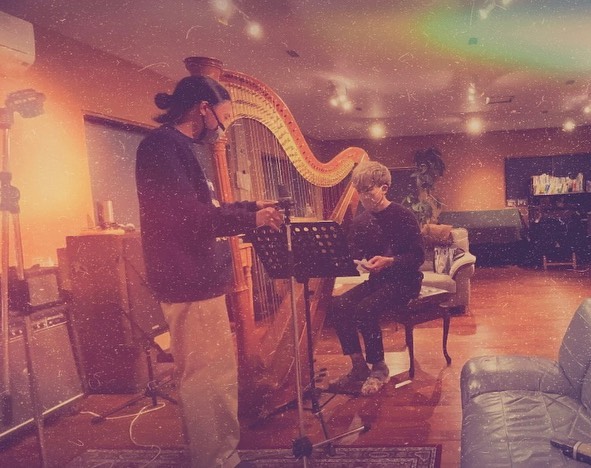
Kadoya: Maybe just Harp Prince. I was looking for a harp player, wondering if there might be anyone in the Kanto area who would agree to play on some pop stuff, and that’s when I discovered Harp Prince. Although I was worried if a regular person like me could even ask someone like him, what with him being a prince and all. But then on his profile it says he’s “the no. 1 most humble harp player in Japan,” so I asked him, and he was totally happy to do it.
During recording when I was giving him direction, saying, “Hey Prince, I want you to play it like this,” I do remember thinking to myself, “If this were the Middle Ages, I would be executed for insolence. Glad we’re living in modern times.” (laughs) Before his actual performance, after I’d handed him the lead sheets and chord charts, he played “Suna no Wakusei” on the harp. It was unforgettable.
— Also, I heard there was a certain guitar riff you couldn’t play so you asked Tanaka Jacob to play it for you. How did you two first meet?
Kadoya: During the recordings for Kaede. We discovered that we lived near each other—even our childhood baseball teams used to be based around the same area—so then we just started hanging out every now and then, just to talk or grab a bite and stuff.
I personally like a lot of Jacob’s songs. I’m not very good at playing those sorts of high-gain, distorted guitar parts, but I knew he could play that sort of thing really well. So I thought, “Hey, I bet Jacob might be able to play this if I just ask!” So I phoned him, and he came over on his bike right away. He was like, “Something like this?,” and he played it just like that and we were done.
One of my favorite guitar tones is that of guitarists like George Harrison and Suzuki Shigeru. I tried looking up what kinds of effects they had used, and I found out that they’d both used something called TS-style (Tube Screamer) overdrive pedals. Later, when I asked Jacob what he was using, it turned out to be something very similar. I thought, “Yeah, that makes sense.” It felt very consistent to me in the sense of, “I guess I really do like this particular sound.”
— And then there was also…
Kadoya: Marcelo Kimura, who did that announcement in Portuguese. And lastly, the violin team. Those were the only new players.
— So there were musicians you’d worked with before as well as musicians you brought in for the first time. What was your impression of the string players?
Kadoya: Up until now, we’d always recorded them one person at a time. That was mainly for pitch issues—it’s easier to fix them that way.
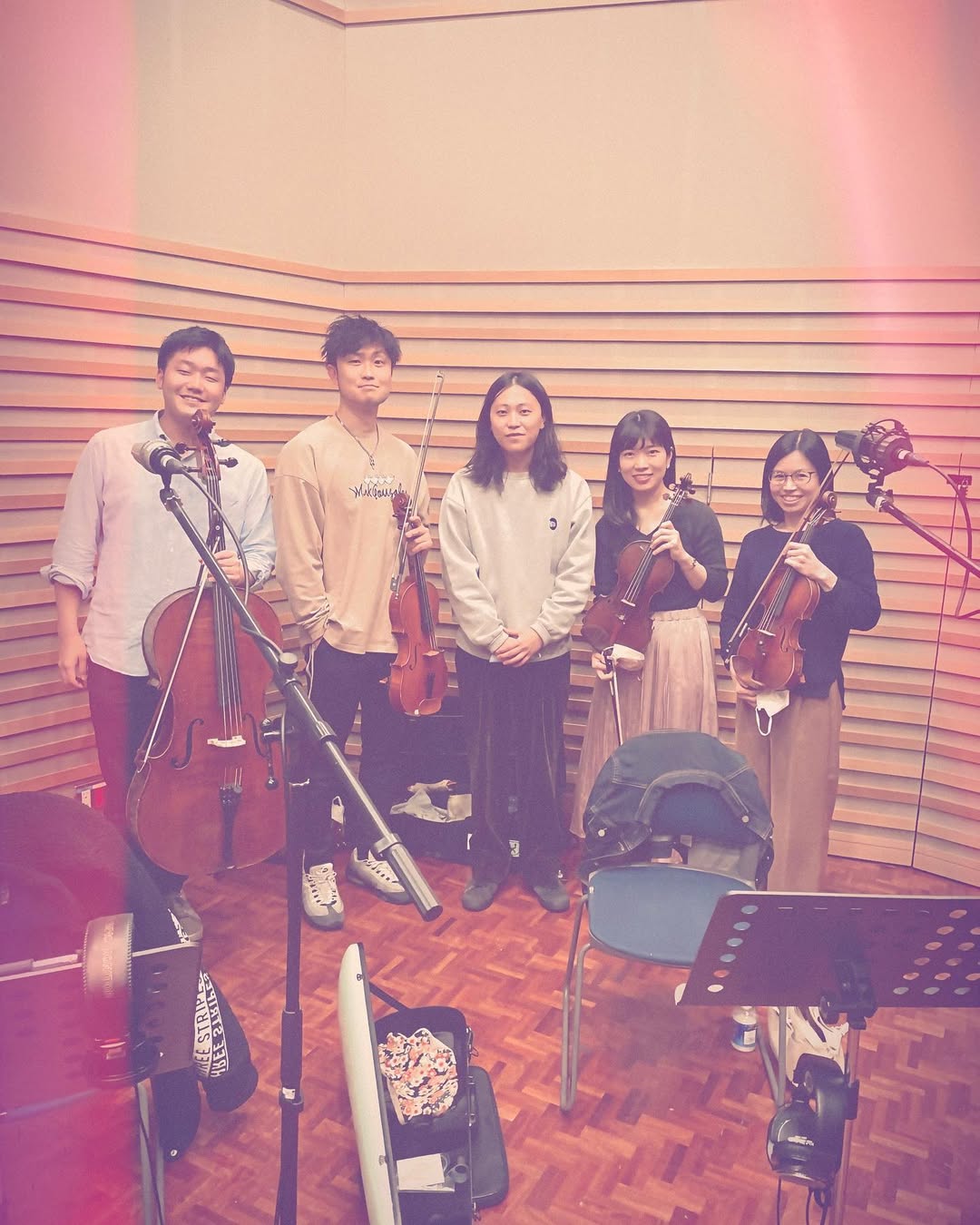
But this time around, I was going to allow those sorts of pitch fluctuations, so we just did it the standard way, which is to record everyone at the same time—recording the four of them performing together. We set up close mics, had them perform several times, and then overdubbed those multiple takes together. That’s how this kind of thing is typically recorded. Ideally, you’d have even more musicians and record them all in one go to add more depth, but what with our limited budget, we resorted to this multi-track recording approach.
— By the way, isn’t this album louder than the first one in terms of overall volume? I feel like it’s closer to the volume of the first album of “unlabeled” Uwanosora, as well as Yogiri.
Kadoya: The first ’67 album was actually quite loud, too. If you made it any louder, the sound would start to crack. It’d basically break down.
While this album isn’t quite as loud as like Yogiri or Heart no Tekagami, it did feel like it shouldn’t be too quiet either. To the ear, it might sound like the highs and lows are a little too rounded; like they’re not present. But in actual fact, they are very much there. I mean, it’s not as loud as like the mainstream stuff you’d normally hear on the radio, but it’s definitely still on the louder side.
— Was that a deliberate choice?
Kadoya: Mmm… Yeah, it was. If you make it too loud, though, it does fall apart. To rephrase, compression reduces the overall beauty of the sound. It’s like a strong drug of some sort: it packs a punch, sure, but it’s difficult to keep enjoying it for an extended period of time.
Rather than following the typical mainstream music sort of thinking, we decided to put priority on the beauty of the sound. Even if it’s probably not the best decision from a business perspective…
— What do you mean by that?
Kadoya: Well, it’s… How do I put this…? I think it’s fine for there to be all kinds of different styles of music, and I think it’s necessary for there to exist commercially-driven music, too. Sometimes, I even feel like listening to it myself. Just listen to whatever fits the mood or situation you’re in.
But for me, I mostly listen to music in a more relaxed setting, when I’m by myself, so I prefer music that suits that situation. Thus, I have no interest in trying to make something that’s just ear-catching in like a stimulating, “auditory shock value” kind of sense… I feel like some people are going to take what I just said the wrong way, but roughly speaking, it’s just the difference between making music for the masses vs. making it for yourself. I mean, it’s all a matter of taste anyway. It’s not a black-and-white thing—there’s no “right answer” here.
— What’s interesting to me about that, though, is that you’re a Marvel fan, right? Wouldn’t you say Marvel films are full of exactly the sort of thing you’re trying to avoid in your music? I guess there’s like a contrast between what you like to watch vs. what you like to create.
Kadoya: When it comes to Marvel, I feel like their producers had a clear idea—at least before they were acquired by Disney—of what makes a film a film.
Unlike music, film-making is more of a capitalistic, big industry thing. It’s a medium that was based on an industry, so it’s like I can enjoy it for what it is. I mean, of course popular music is like that, too, but with film it’s like that side of it is even more emphasized. It could be that I just like it because it’s an easy way to help pass the time. It’s just entertainment.
— Was there anything that influenced specifically this album, whether it be music, film, or books?
Kadoya: I had more free time for watching movies after we finished the Kaede project in 2020. I’m pretty sure I posted a summary of all the movies I watched on Instagram. Give it a look.
In terms of literature, I was influenced by Abe Kobo’s The Woman in the Dunes. Also, specifically with the song “Manatsu no Echo,” I feel like I was influenced by the vibe of Murakami Haruki, as well as Watase Seizou’s Heart Cocktail.
— Anything else that you feel may have inspired this album? Something in your daily life, or anything else…
Kadoya: I’m always listening to ’60s stuff, so I was of course very much influenced by that whole sound… Besides that, I’m also influenced by the broader trends of our times.
— This is just my personal take on it, but compared to the music on Hidamari and Yogiri—and especially Uwanosora ’67’s first album—I feel like on this album there is much less of a clear sense of what inspired each song.
Kadoya: Sound-wise, while there may be parts that make you think, “Ah, this reminds me of something else,” that sort of thing is something I’ve gradually started to care less about.
As someone who makes music, I’ve always wanted to stay true to my roots, and as a listener, I’ve enjoyed listening to music where you can really get a sense of the artist’s foundational influences. Rather than the artist saying, “Yeah, this just came to me. It’s my original thing—I invented this,” when really it’s just a jumble of their various subconscious memories… I always felt like it was okay to just clearly state whatever your influences are, and I’ve often tried to express my influences in my own works. But I feel like there might be less of that on this album.
In terms of visual media, I think something like Stranger Things strikes the ideal balance.
— Also, on this release, I get more of a “home recording vibe” rather than a “band vibe”… Or like, whereas up until now it had always sounded like the two of you in Uwanosora plus all the guest musicians, on this album I get this feeling of strong determination of like… “We made this. The two of us. Uwanosora.”
Kadoya: I feel like maybe I’ve become better in some ways at expressing to other people the sound I’m going for; how I want it to be. Part of it might also have to do with how the drums were recorded.
Also, while the top-layer elements—strings and brass—had featured on all our previous albums, too, we used them more sparingly this time, opting mostly for backing vocals instead. Maybe those are the kinds of things that made you feel that way.
— Would you say you were consciously trying to make it sound like that, or that it just happened to turn out that way?
Kadoya: It’s more that it just turned out that way. I’d say our previous works all sounded pretty “macho,” whereas I think this release sounds a bit more relaxed… Although I’m not sure. It’s like the ingredients are still the same—we just plated it a certain way. That’s the sort of subtle difference I’m talking about. Like, the sort of plates you use and stuff.
— Ah. Hearing you put it that way, I feel like I picked up on that, too.
Kadoya: It’s less “flashy” so it might feel cosier in a way. But in terms of how it was made, there wasn’t actually much of a difference.
— Next, I’d like to ask you about the lyrics. While you mentioned that every part of the songwriting process takes time, I was wondering: if you’re able to write the lyrics to a song rather effortlessly, do you feel like that tends to make the song better? Or does it not matter?
Kadoya: It doesn’t really matter.
— Which lyrics do you think came out especially well?
Kadoya: “Manatsu no Echo.” At least in my mind, that one came out good. Although those kinds of lyrics just don’t seem to be a hit with people, so in that sense it didn’t come out good at all. (laughs)
— What gives you a sense of accomplishment when it comes to writing lyrics?
Kadoya: Things like if I feel that I came up with a particularly adept turn of phrase, or if I’m able to properly express the scenes I’m imagining in my mind.
— Conversely, were there any songs that you really struggled with?
Kadoya: Maybe “Hachigatsu no Nami.” I kept agonizing over the lyrics of that last chorus. But really, it’s always just a problem of how to best say what it is that I want to say; what words might fit best…
My songs don’t have a lot of melodies, so I can’t just go off and say everything I want to say as if it was rap music—not that I know what rap music is even really like, so that might be misleading of me to say. In any case, the melody is structured almost like a nursery rhyme, so I spent quite a long time struggling over which words I could fit in there.
— When you’re thinking about a lyric, do you often change even the parts of it that you weren’t agonizing over?
Kadoya: All the time. “It sounds better like this.” Stuff like that.
— So almost none of your lyrics are just “one and done”? It’s always a more time-consuming process?
Kadoya: Right. I’ll finish writing a lyric, look at it again the next day and go, “Hmm… I think I’m going to change this bit here.” It’s just endless trial and error.
— I once heard you talk about how writing lyrics is difficult for you because you write them based on your personal experiences, and that imposes a limit on what you can write about. What are your thoughts on that now?
Kadoya: I probably said that around the time of our first album… I do still think that I can’t create something that’s not already in me, so in some ways I still agree with that. But at the same time, I feel like now the majority of my lyrics are imaginary stories.
— Right. Every once in a while, you’ll come out with a song that has a bit of a science fiction feel to it. Is that something you try to do intentionally?
Kadoya: It seems to me like I might have a bit of that Marvel, Thanos-type thinking—you know, snapping your fingers and suddenly half the population disappears. On the last album I wrote about a falling meteorite (“Inseki no Love Song“), and on this album I wrote about an entire town being engulfed by waves (“Mirai Seiki Yokohama“).
But they’re also songs about different forms of love or the human drama that’s born in that instant. It’s basically like an extension of my sense of aesthetics—I think I just like to think about what happens in those final moments of one’s life; how people’s feelings change; the whole scene. And I guess I’m also drawn to that sense of inadequacy… That feeling of helplessness or powerlessness. I personally like works which feature themes like that.
— Speaking about your lyrics as a whole, rather than a “crisp and dry summer,” the impression I get is more of a “humid summer,” with a bit of “separation” on the side. Are you conscious of that kind of thing in your writing?
Kadoya: The feeling of “humidity”—yeah, could be. There’s none of that dry, early Beach Boys, summer party vibe. Rather than the kind of, “Yeaaah! Endless summer, baby!,” I feel like Uwanosora just tends to drift more towards our particular style of expression. I also didn’t want to go overboard in my use of the sort of surrealist vocabulary either.
— Do you think that has to do with what you are yourself like as a person? Or is it more, “This is the kind of song we’re going to do, so the lyrics ought to be like this“?
Kadoya: I mean, I do have a bit of that party guy inside of me, too. But I’m also kind of a nerd, and when I start injecting that into my songs, it hardly leaves any space for the party guy to come out. (laughs)
— The nerd wins out over the party guy? (laughs)
Kadoya: Oh yeah. By a landslide. There’s zero “party mood” in our songs. And so, even though I might like to think I’ve got a little party guy inside me, in reality it could be that it’s really not much of a party guy at all.
— While “summer” is an overarching theme on this album, another recurring motif in the lyrics seems to be “endings.” For example… In “Ame ni Naru,” it’s “the end of summer.” In “Giorno,” it’s “the final destination.” In “Sameta Cardia,” it’s “the end of my longing.” In “Last Dance wa Boku to” it’s the “last.” In “Mirai Seiki Yokohama,” it’s the end of Yokohama—and of the whole world. In “Manatsu no Echo,” it’s the person who ends up all alone… It definitely feels like “endings” is a running motif on this album.
Kadoya: That’s right. It all ties into how summer itself has an ending.
We’ve been talking about the aesthetics thing—that’s something I’ve always continued to write about. As the end of summer starts to approach, it always makes you feel sad, right? Speaking about Uwanosora’s music so far, I’ve always wanted to write about the things regarding the human spirit that never change. I mean, I do embrace change and all that comes with it—I’d even say I like it—but even so, I feel like there are aspects about human nature that never change. I’ve always wanted to treasure those things in my songwriting.
Even though people often say our music sounds like this or that, that’s only scratching the surface—it’s really just one aspect of what we’re trying to express with our music. Or, that’s what I’ve always tried to create anyway; that overall picture. Like… How you feel sad at the end of summer; how you feel excited at the beginning of summer; how you feel sad when you’re going through a break-up. Those are the sorts of things that have always been the theme of our music.
So if I was to make an analogy between summer and my time in Uwanosora… While “Sameta Cardia” is a song about a romantic relationship that’s come to an end, with the lyric “Omoi no hate ni nani mo nai no ka” (“After all this, is there really nothing more?“), I actually wrote that also as to say, “I’ve been doing this for so many years, but this might be it for me.” So, “The End” in that sort of sense.
In “Hachigatsu no Nami,” the line “Natsu wa itsudemo koko ni aru to” (“Summer is always here“), I wrote that with the implication that at least on this album, it’s forever going to be summer. So I’m using “summer” in a conceptual way, trying to express that the moment that it ends, all kinds of imperfections will begin to emerge. It’s that sort of thing which ties into that obi blurb: “With gratitude to all summers.”
— To take that even further, I also couldn’t help but feel that “the universe” was the album’s hidden sub-theme. To me, it’s like it tells the story of “the end” from both the planetary as well as the cosmic perspective, with “Suna no Wakusei” talking about how it looks like from space, and then “Hachigatsu no Nami” closing the album with a view from Earth… Although I have no idea if that was actually the intended message.
Kadoya: While I’m not sure if this answers your question…
The lyrics of “Mirai Seiki Yokohama” tell this story of a planet where you need “neither love nor credit cards,” but rather than going somewhere like that, the protagonists decide they would rather just stay there, in a Yokohama soon-to-be-engulfed by the ocean, and swim.
In “Suna no Wakusei,” we go to that planet, but—wouldn’t you know it—the humans are at war. There are people laughing scornfully at this woman who has lost her lover, but then it goes, “…And yet I find myself gazing at you.” So the point is how even in such a sci-fi-esque setting, surely there are things about the human heart that never change.
I’ve been quite influenced by Procol Harum’s A Whiter Shade of Pale. It’s a song about the Vietnam War from 1967, so it’s been over 50 years since its release. The lyrics are about a girl left behind by her boyfriend who has gone off to fight in the Vietnam War, and so she waits for him, high on drugs, her face “turning pale.” And today we’re still at war just the same—nothing has changed.
It’s my first time writing lyrics with “war” as the underlying theme, and I didn’t want to just write, you know, “war is bad” or whatever. I personally don’t want to put strong messaging like that into my works—though that’s not to say that I’m by any means “pro-war” either. Really, I’m just passively watching the news as they go by. That’s all. I can be nothing more than a bystander. That’s the sort of feeling I tried to incorporate into the lyrics.
It’s basically just me picturing a scene in my mind, and just for a moment something beautiful happens within that scene, and I sketch it out in words. I think it should give one a sense of the world ending, on both the macro and micro level. It’s kind of lame, explaining one’s own lyrics like this… Ah, whatever. (laughs)
Simply put, it’s like… Say you’re out for a walk when suddenly you catch the scent of fragrant olive blossoms on the wind, and there’s just that ever-so-slight feeling of excitement when you do… I’m just trying my best to describe feelings like that from different angles and in different words. That’s how it feels to me. Mmm… Although, since it’s such a sensory thing, it might actually be impossible to put it into words.
— At what stage did you decide on the album’s song order?
Kadoya: They’re in the order that I wrote them. The only exceptions were that I’d already decided “Ame ni Naru” was going to be the first song and “Hachigatsu no Nami” the last song, but apart from those two, it’s mostly in the order I made them.
— Is that how it usually goes with all your albums?
Kadoya: Basically, I’m always making our albums with the intention that I want to release them on vinyl at some point. So when you flip to the B-side, I want it to start with an uptempo tune—that’s why I put “Manatsu no Echo” there. From tracks 1 to 5, it should be a gradual shift from uptempo tracks to ballads. Then, from tracks 6 to 10, it should suddenly be a lot more ballad-heavy. That’s how I want our records to be. I think about the overall balance of it all, lyrics included.

— This is going quite a ways back, but I wanted to ask you two about your most recent performance, “Uwanosora/Uwanosora ’67: 7 YEARS LIVE” (at Moonromantic, Aoyama, Tokyo).
Kadoya: The show we did on 3 August 2019.
Iemoto Megumi: So exactly two years ago? Since today’s August 2nd…
Kadoya: Ah! Wouldn’t that make it exactly three years ago tomorrow?
Iemoto: Oh, right. Three years ago.
Kadoya: I doubt there are any other bands out there looking back on one single show… (laughs)
Iemoto: (laughs)
— You haven’t spoken in public about your feelings in regards to the show?
Kadoya: Just briefly when we were invited on a radio show, but other than that, I don’t think so.
— So how was it? Is there anything that you still remember vividly from the show?
Kadoya: It still hasn’t worn off for me even now, three years later. (laughs) Because, I mean, we haven’t played any more shows since then, so the memory hasn’t been overwritten by anything else. I’ll watch footage from the show over drinks when I’m by myself. For everyone else who was there, it’s probably already faded from their minds and hearts, but for me, I’m still thinking about it. That’s where I’m at with it.
— How about you, Iemoto?
Iemoto: Well, I was extremely nervous, so I wish I could’ve sung more naturally—there were many points of reflection for me. I did have a lot of fun though. But I’m not completely wrapped up in the afterglow of it still like Kadoya. (laughs)
Kadoya: Yeah. For me it’s still like this feeling of, “The show’s finally over!” (laughs) I feel like I could probably live off of this lingering feeling for the rest of my life. (laughs)
Iemoto: (laughs) That’s pretty amazing. For me, it wasn’t to that extent. I was back to my daily life pretty much right away afterwards.
— But Kadoya wasn’t?
Kadoya: I was just totally empty—like my soul had left my body. I’d just be staring out the window, my consciousness drifting in the air.
— Until when? Even now?
Kadoya: Mmm… The first six months after the show were especially bad. I’d be trying to listen to music but everything would sound all the same. “Everything just has a rhythm, harmonies, melodies… It’s ultimately all the same.” I’d be thinking these sorts of silly thoughts. Just thinking negatively about everything. “Man, what the hell have I even been doing all this time…?” Wondering what would even be the point of me making anything more.
After it ended, I was just completely exhausted. But after we’d all worked for it so hard, hearing from the people who’d actually come to the show, saying how they thought it’d been great… I couldn’t help but feel something welling up inside me.
— It’s certainly true that live shows are practically your only way of interacting directly with your listeners.
Iemoto: It was nice seeing how there were so many people who came to see us.
Kadoya: Even though we’re a group who basically only just puts out studio-recorded music, being able to have people hear us not in just the usual stereo sound but right there, in that space… That moment did feel nice. It was a strange experience—one that I feel like I may never get to experience again, knowing my stance on things.
Iemoto: Another thing was that we were all lodging together at the time so we could prepare for the show, so I wonder how that would all work if we were to do another one… I don’t think we could go back to lodging together again. It’d be difficult.
Kadoya: And then there’s the issue of how much we can actually pay everyone. Yeah, it’d be cool if I could say we’re all just doing this out of sheer passion, but the fact is that we simply can’t keep doing it this way indefinitely.
And while that last show did eventually sell out, it took around five months after the tickets first went on sale. Had it been sold out right away, maybe then I might’ve thought, “Okay, I suppose people are going to come see us again if we play another show.” But honestly, I don’t think that now. The truth is that I’m too scared to put on another show.
— I see. Still, it would be nice if one day you could do another show, in one form or another. Moving on to other topics… This is a question for Iemoto. Did this latest album feel in any way different compared to your past albums? Or was it basically the same approach as always?
Iemoto: It was basically the same. I didn’t change anything in particular. But for this album, the overall image was… How should I say this…? Maybe I feel this way especially because our last album, Yogiri, was so mature, but I felt so young again singing on this one. (laughs) But the thing that was the same as always was that I wanted to sing like myself, and in a way that was fitting for the album.
— Were there any songs on this album that were easy to sing?
Iemoto: Something like “Isshuukan Diary” was fun for me to sing. I love that one. And “Hachigatsu no Nami” just feels so good to sing. I think that’s a great song.
— I’ve never seen you when you’re recording vocals. When it’s just the two of you working in the studio, is it always mostly the same? Or has it changed in some ways throughout the years, with each successive album?
Kadoya: No. There hasn’t really been any change.
Iemoto: Except he might be getting more and more strict with each passing year.
— “Strict” how? In what way?
Iemoto: Since we’ve known each other for so long, we’re able to be honest and say what’s on our minds. We do fight sometimes. That’s a good thing though—it’s arguing for the sake of making the album better.
— What kinds of things do you argue about? Anything that’s especially left an impression?
Kadoya: Hmm… I actually don’t remember.
Iemoto: I can’t remember anything specific either… But it’s like, he’ll yell out, “No! That’s wrong!” But then similarly when I do a good job, he’ll praise me for it. Kadoya is the sort of person who thrives on praise, and so am I.
Kadoya: Who isn’t? No one thrives on scoldings. (laughs)
Iemoto: It could be though that you’ve scolded me so much that I’ve developed a kind of resistance to it.
— So you’ve built a tolerance over the years. There’s also a music video (of “Ame ni Naru“) that features you both. Do you have any thoughts on the video?
Kadoya: We’d been planning that since around May 2021 with director Abe Yukiko, and since we had a lot of time to make it, we talked about how we wanted to give it this sense of the changing seasons. We actually wanted to shoot it in the late summer heat of September, but I don’t know if it was because of the title of the song (“It Will Rain“) or what, but it was just raining constantly so we couldn’t do it.
So by then it was October and the Chinese silver grass had started to appear. We went to Asagiri Plateau (the filming location) the previous day, spent the night there, and then filmed from six in the morning until sunset. Then on a different day, in November, we filmed in Yokohama in places like Negishi Park and Yamashita Park that have ginkgo trees. Then around late May this year (2022), we shot in Yoyogi Park and other places around Tokyo, and then we were finished filming.
So the video shows three different seasons: early summer, the end of summer, and autumn.
— So it was a long shoot. As for the cover art, it’s very green. Your album covers are always so different. Is it mostly the two of you who work on them?
Iemoto: Kadoya gave me some reference material—pictures of all sorts of different album covers—and I used that as inspiration and suggested several different design patterns, until finally we ended up going with this one.
— Sounds quite arduous.
Kadoya: Well, we went there together.
— Oh, you mean the cover shoot itself.
Kadoya: That was actually pretty intense. We broke a camera and everything.
Iemoto: There were so many good shots, it was tough to decide on the best one.
Kadoya: Thankfully, yeah. Although I also feel like any one of them would have been just fine.
— Was there anything that made you decide on that particular photo?
Kadoya: I liked the composition of it, and I also felt like there was something “old” about it. The theme is summer, yet it’s not at the summer beach or something—I don’t think it’s a picture that particularly makes you think of summer. It kind of disrupts expectations in a way. We could have just taken it at the poolside or whatever to immediately give it that image, but it felt like it would’ve been a bit gimmicky to do that. Something slightly more grounded seemed appropriate.
We also wanted to link it with the world of the lyrics. So rather than a light, carefree summer, the cover is more reminiscent of that heavy summer humidity.
— Here’s another question for Kadoya. Do you ever struggle forming your image of the song you’re working on? Do you ever have times when you’re just not coming up with any new ideas? What do you do when that happens?
Kadoya: The only thing I can do is to keep trying. I listen to all kinds of different songs for input, banging my head against the wall as I make something. I can only pick up my guitar and get on with it—otherwise, nothing happens.
— What do you do, Iemoto, when something’s just not working for you?
Iemoto: I just practice. We start by recording demos which gives me an idea of what I should be doing, and then in recording I just keep working on it and working on it until finally I see what it’s supposed to be.
— Is that something you can figure out quickly once you get into recording?
Iemoto: There are some difficult songs on this album, but nothing that I thought was especially difficult to sing. Compared to the first ’67 album, Kadoya wrote the songs to be easier for me to sing, and in the end I think I was able to sing all of them well.
— Were you conscious about making the songs so that they would present Iemoto’s vocals in the best light possible?
Kadoya: Yeah. Although, truthfully, it’s hard to aim for something like that until the song is finished—I’m busy with the actual writing itself. When it comes to stuff like adjusting the key, there are times when I’ll think the highs feel a little too intense so it’s better to bring it down a half-step, and so on. I feel like with experience I’ve gotten a better sense for that sort of thing.
With “Sameta Cardia,” for instance, it was originally all in the same BPM as the verse, but then as it got to the chorus it just sounded too dense and hard to listen to, so I slowed down the BPM only for the chorus. It’s the same tempo for the verse and bridge, but then it slows down at the chorus—I did that because I felt the vocals would have more room to breathe that way. Those are the sorts of adjustments I sometimes make for the sake of the vocals.
— Is it something you just learned to do along the years?
Kadoya: It’s just… I’ll listen to it and I might notice, “Yeah, that’s too cluttered.” Then I adjust the arrangement accordingly, looking at the big picture, vocals and all.
— In recording the vocals for this album, did you have any special orders for Iemoto?
Kadoya: I did. Not singing too powerfully, for one. As a songwriter, I’m just not fond of music where the main vocalist is too in the forefront. The whole diva songstress type of thing—that’s not something I’m interested in doing.
— Has that always been the case? Do you share the same sentiment, Iemoto?
Iemoto: Yes, that’s something we’ve always agreed on from the start.
— What do you suppose you want to do next? Do you have any sort of vision?
Kadoya: I actually want to play live again—despite all the stuff I was just saying minutes ago. (laughs) I’m glad when people say they enjoy our albums. It makes me happy to get positive comments on social media, and it makes me happy to see people having a good time at our shows.
But lately, I’ve just been in this “I quit” kind of mindset… (laughs) If we do make another album, I feel like it might sound totally different.
— …The idea of which sounds quite interesting, too.
Kadoya: I want to be more free, more casual, more loose with how we do things.
— How about you, Iemoto?
Iemoto: I do want to play live again… Being able to sing while seeing everyone’s faces is a special thing for us. Getting to hear from our listeners directly is really a precious thing.
Kadoya: We put all this effort into making CD-Rs that we only sold at the venue, only to later see them being resold for high prices. Not only do the resellers get their ticket money back, they actually make a profit doing it. It’s such a downer, seeing that kind of stuff. So we can’t do things like that anymore, because now we know there are people like that out there. It’s something we did for the sake of having people come to our shows; to make our listeners happy, so it really sucks.
However, I’ve recently been making some a cappella stuff pretty much just for the fun of it, so maybe instead of CD-Rs we could give out like download cards for that. Honestly, all this stuff about me wanting to play live is just an excuse for making people listen to my a cappella stuff. (laughs) We even wrote on the CD-Rs not to resell them… It really is sad to see. I wish people would stop doing that.
In any case, we’ll do our best to be able to play live again.
— Any message to listeners who bought the album?
Iemoto: First, thank you to everyone who bought it. It’s a rare thing these days for people to be buying CDs, so I’m grateful that people would go that far just to be able to listen to our music. It’s very encouraging for us. I’m just happy if people can find even a little bit of enjoyment in the album.
Kadoya: I feel exactly the same way. You wouldn’t buy someone’s CD unless you really liked them, and even though we put up the pre-orders before even releasing any previews from it, we received quite a lot of pre-orders right away. A moment ago I was talking about those resellers, but of course those people are only a minority—I do realize that most people are genuine supporters of our band.
It’s going to sound lame when I say this because people can’t see the hard work that goes into the songwriting and other things that happen behind the scenes, but I’m going to say it anyway. Every time we make an album, I’m doing it as if my life depended on it. I’m literally devoting huge parts of my life to it.
In the beginning, it mostly felt like I was making music only for myself. But gradually, that sort of passion starts to not be enough anymore—you start running out of gasoline. In times like that, I think about how there are people looking forward to hearing new music from us, and that gives me energy. When I see comments from people saying they like what they hear, it somehow makes me feel like trying my best again. It’s weird—I thought I had only ever been living for myself. In any case, I can only express my gratitude.
Of course, we can’t make these albums by only the two of us. We make plenty of mistakes, and especially in my case, I have to go through a long process of trial and error in order to make something I’m genuinely happy with. So all of the people involved, all the CD shop owners and such, all the listeners who buy our albums—my belief is that everyone plays a part in shaping our music. As always, I’m very grateful to all these people.
— Also, as it says on the obi, “With gratitude to all summers,” you said you wanted to release this album specifically in the summer. Any thoughts in regards to that?
Kadoya: We were running behind schedule and I was starting to worry that we wouldn’t be able to release it in early July like we had planned. But we had this song “Isshuukan Diary,” and the lyrics of that song are almost like a diary, describing a week starting from August 1st. So while it looked like we wouldn’t be able to release it in time for July, I wanted to at least have people be listening to this song by August.
I discussed it with Tamada, our engineer, and we decided to give it our best shot. That just got us so fired-up. I’ve always found that listening to certain songs in certain times of the year, it makes them part of my memories. I’ve had lots of experiences like that. Like, “I was constantly listening to this song that one summer.”
Now these songs that were about to be released from our hands would live on within our listeners. That’s something I want to continue to appreciate. Sure, I’m also writing for people way in the distant future; people who are only going to discover these songs maybe decades from now. But I also think about these songs as they live and are being brought up within the hearts of people who are alive now.
That was important to me, and so we somehow managed to get it out by summer.
— In conclusion, could you tell us about the video project that you worked on alongside this new album?
Kadoya: This originally came about when a friend of mine said to me that although he wanted to hear new songs from us, he also wanted to know just as badly the process of how we actually make them. I thought it was an interesting idea, so we just kept the cameras rolling throughout the entire production process. I wanted to show every single part of the process as much as possible.
However, as there is two years worth of footage (from 2020 to 2022), it is an enormous undertaking. I can only imagine how difficult it will be to edit and to even just watch through all the footage. There’s also going to be an acoustic live performance sandwiched in between that footage, and the video will have songs on it that aren’t even featured on the album itself, so I do think it’s going to become a must-see item for Uwanosora fans.
Also, I can’t even imagine how helpful it would’ve been for me back when I was myself in university if I could’ve seen a similarly detailed production documentary from a Japanese pop songwriter or band of the same era.
Uwanosora have always been self-produced, so in the beginning we didn’t know left from right. We spent a long time just trying things out through trial and error. I do feel like, had I seen someone else’s “how to” video back then, it would’ve been a big help. So this is also almost meant as like a letter to future songwriters who are going to give us cool pop music to listen to. Or, like, as some actual reference material they might use. Sort of in the sense of, “This is how we as musicians made an album around this time period.” There’s detailed explanations as to what mics we’re using and all the rest of it. It’s great to watch music documentaries of like all the stars from the ’60s and such, but I feel like this might come across as something a bit more real.
Mmm… Well, when all’s said and done though, the real highlight of the documentary is getting to see me grow my hair over a period of two years until finally I have long hair at the end. (laughs)
Iemoto: I think after you watch this documentary, you will feel whole new emotions when you listen to the album again—like hearing it in an entirely different way. Please do look forward to it.
— Thank you for your time today.
