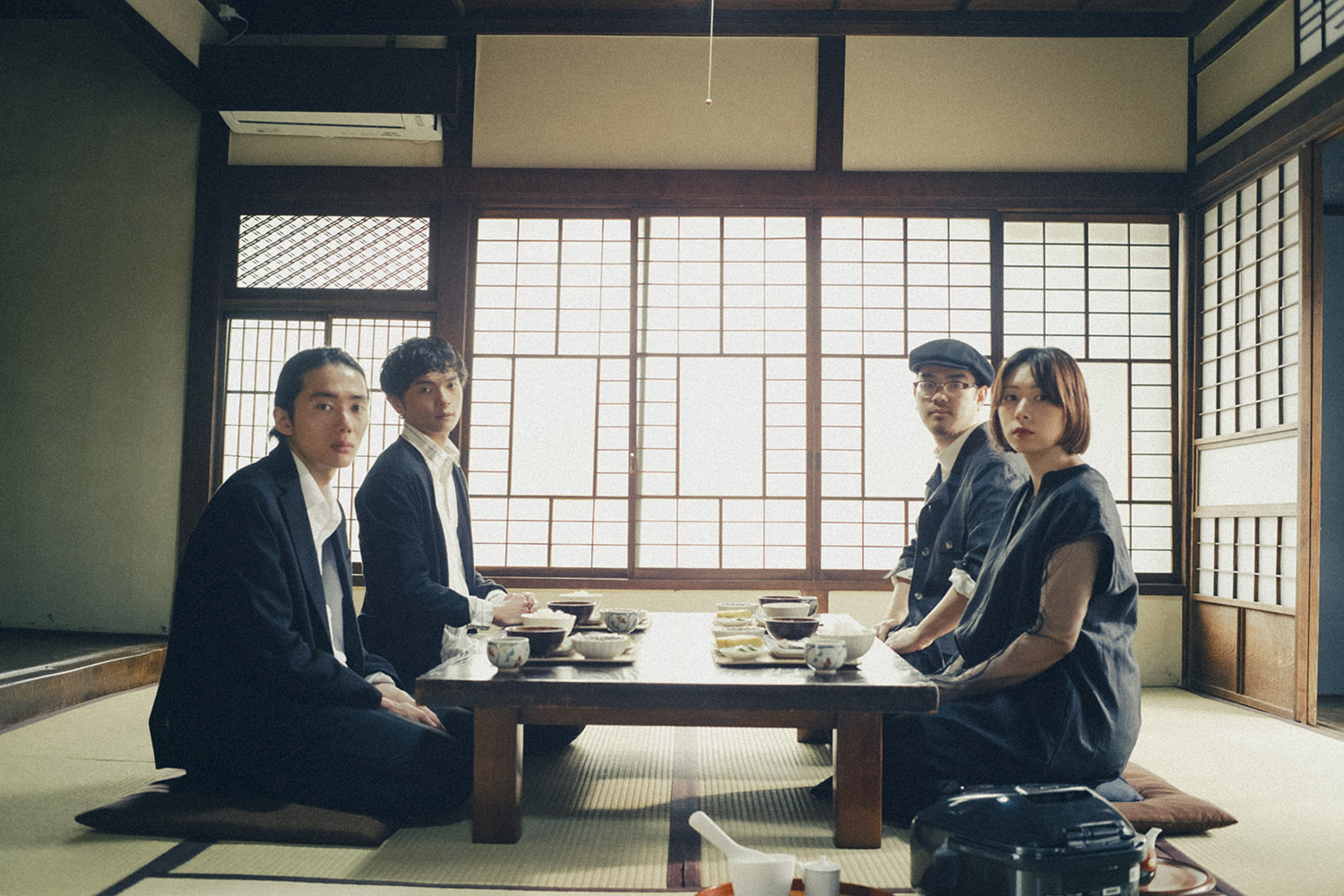
Here is an interview with MONO NO AWARE about their fifth album, The Buffet.
While it is unfortunately not discussed during the following interview, I do very much feel that the single “Kaze no Muki ga Kawatte” is another obvious career highlight for the group in its own solemn yet strangely easygoing way.
Interview & text: Tosa Ariake (Japanese text)
Photography: Masuda Renzo (source)
English translation: Henkka
MONO NO AWARE: Website, Instagram, Twitter
Note: You can buy this album on CDJapan.
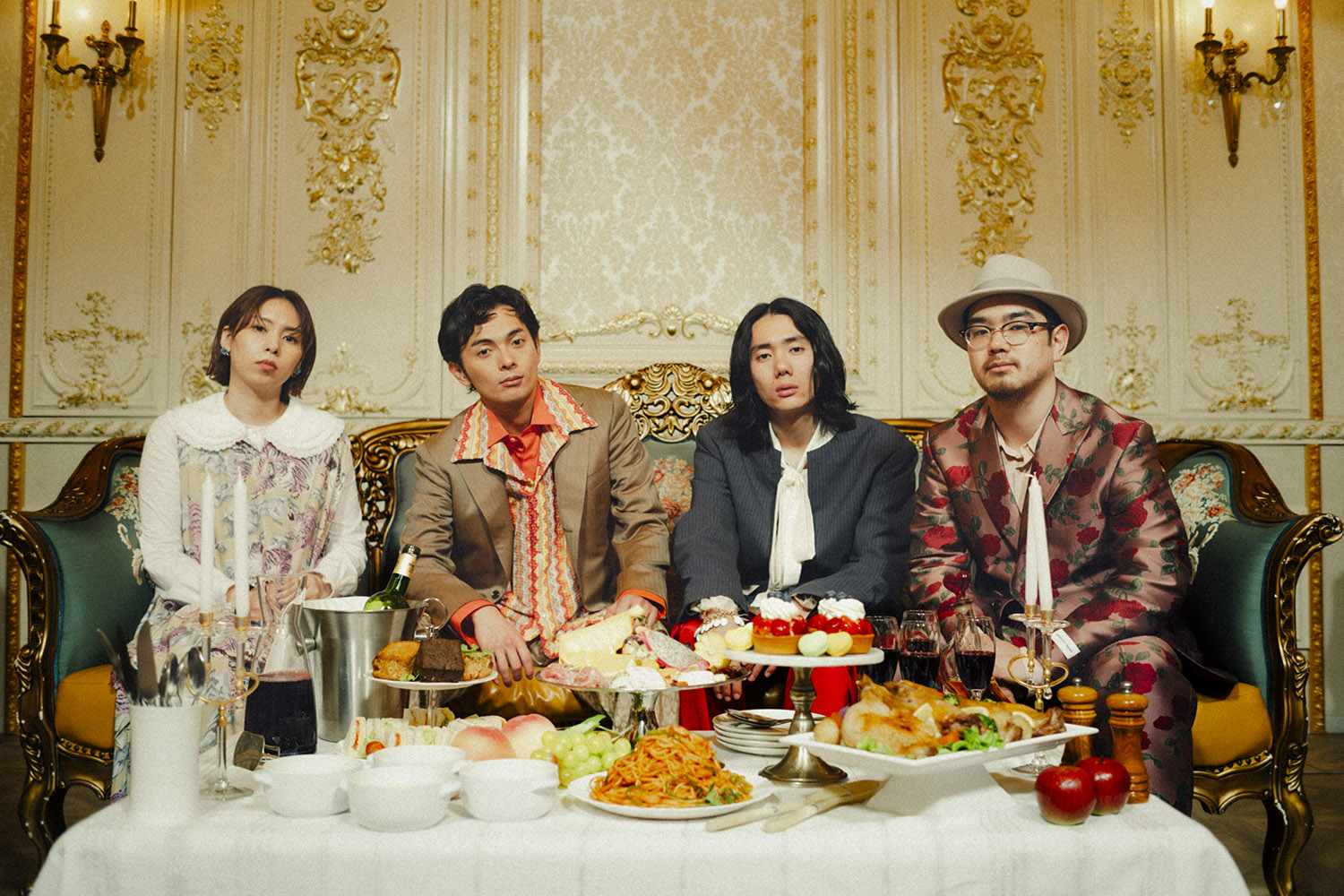
MONO NO AWARE
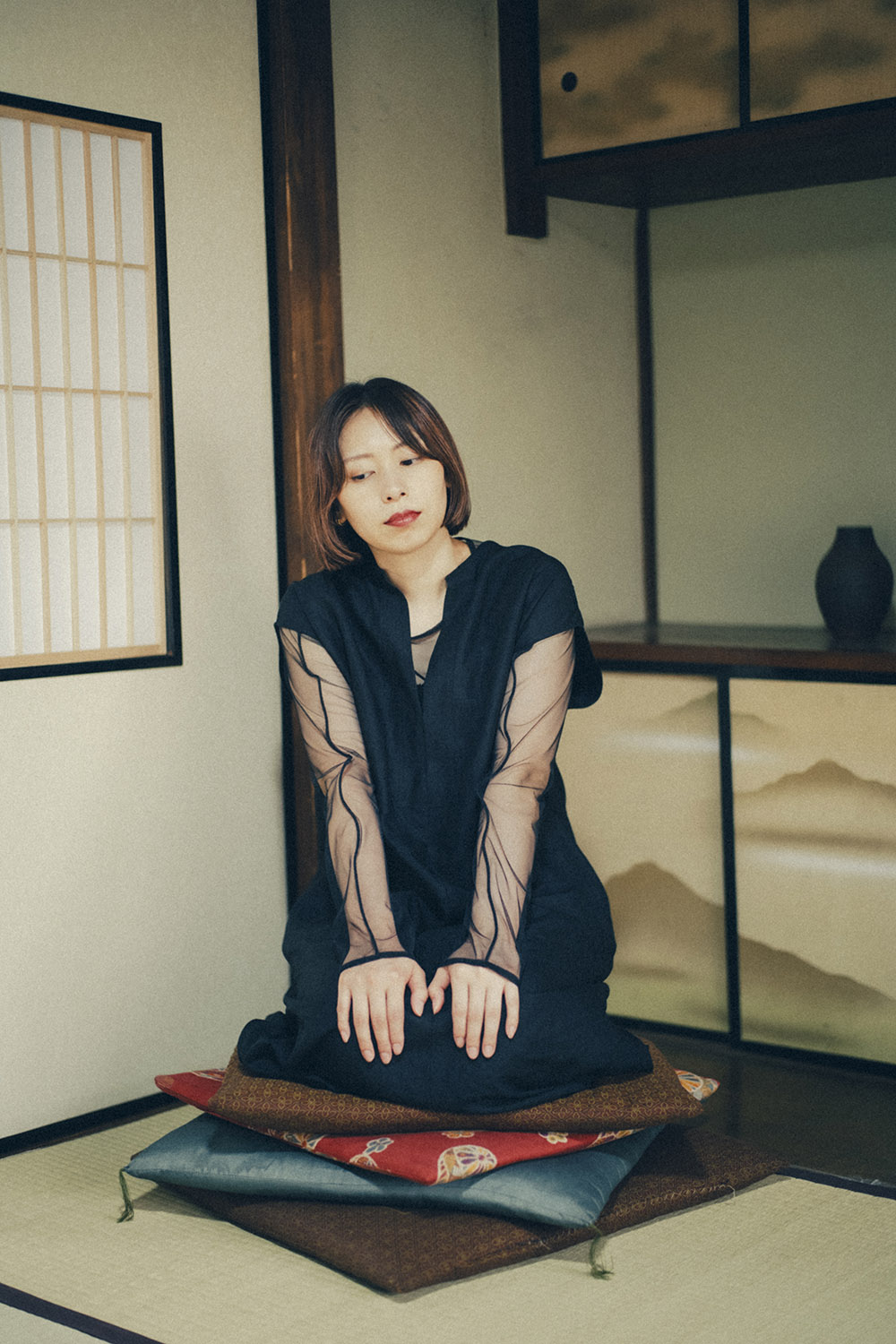
Takeda Ayako, Tamaoki Shukei, Kato Seijun, Yanagisawa Yutaka
MONO NO AWARE—a four-piece band with catchy, hook-filled melodies and an all-original sound. Yamaguchi Ichiro (Sakanaction), Mukai Shutoku (ZAZEN BOYS), and Yonezu Kenshi are just some of the people who hold this group in high regard.
Arriving approximately three years after their previous release, Gyouretsu no Dekiru Hakobune (2021), their new album is titled The Buffet. According to vocalist, guitarist, and songwriter Tamaoki Shukei, the album’s title reflects certain feelings which were influenced by the post-COVID era. But beyond that, what really deserves one’s attention—astonishment, even—must be the album’s totally organic, three-dimensional band sound. The way all of the instruments intertwine to create a multi-layered ensemble, it is a clear testament to just how much all four members have grown and matured in terms of both their skills and their creative ideas.
We sat down to talk with Tamaoki Shukei, Kato Seijun (guitar, backing vocals), Takeda Ayako (bass, backing vocals), and Yanagisawa Yutaka (drums, backing vocals).
— In your promo materials, you describe the album as being “filled with a sense of play.” Indeed, it does come across as a feel-good record with a lot of playfulness and humor to it. Even just the tone of it as a whole seems a lot more cheerful compared to your previous release.
Tamaoki Shukei: That’s the first time anyone’s ever said that, but it’s the reaction that makes us the happiest to hear. Our intention was to make a feel-good album, even though people seem to interpret it as something more serious…
— The album is called The Buffet. At which point did this title emerge?
Tamaoki: We had a meeting between us and the designer where we discussed how we wanted a theme that was about some place where people who are from totally different communities can meet, and the question was, “Where exactly might that be?” Airport terminals, public bathhouses, coin laundries—we floated several other ideas, too. But we ended up going for “buffet” because it’s a fun setting in the sense that it’s all-you-can-eat and you’re gathered there with people you usually wouldn’t interact with, and there’s only one thing on everyone’s minds: eating some food.
— You trying to think of places where people might gather like that—did that have anything to do with COVID by any chance?
Tamaoki: Yes. Last year, as things started opening up after COVID, you finally started seeing crowds in all sorts of places again. But during the pandemic, it felt like everyone was constantly monitoring everyone else’s behavior, like everyone was only concerned with keeping up appearances. I was consciously trying to bring the focus back to the individual; to the self. Some of the songs we’d already released from the album were based on a similar theme, so we decided to frame the whole album around that perspective.
Takeda Ayako: Weren’t you saying how, since our last album had been a bit darker, you wanted to change it up by making food the central theme on this album? Everyone sitting down to eat at the same table even though it feels awkward—it symbolizes the idea of coexistence.
Tamaoki: Right. Rather than make it be about the messiness of human relationships or about the difficulties of living in general, I wanted to make this an album that, in a way, forcefully breaks through all that. If anything, I wanted to go in a more comical direction and make something more feel-good.
Also, the word “buffet”—even just phonetically speaking it’s a pretty disarming kind of word, isn’t it? (laughs) I wanted a title that didn’t feel stiff, and I wanted an upbeat theme.
— There are a lot of puns in the lyrics, too. “Nikutarashiku,” (“hateful,” except for the “niku” it’s the character for “meat” instead of “hate“), “onushi wa kuwanedo itsumo youji” (“even as you go hungry, you’re always so very ‘busy’“—a spin on the well-known proverb “bushi wa kuwanedo takayouji” (“even as the samurai goes hungry, he still maintains his dignity“), “osasshimi” (mixes the phrase “osasshi kudasai” (“please understand“) and “sashimi“)… (laughs)
Tamaoki: Indeed. (laughs) Although I worry that it might cause listeners to focus too much on the lyrics. I mean, I do write lyrics that have obvious “messages” to them, but if we were to only rely on that, there wouldn’t be much point in us making music as a band. What matters more to me are the discoveries the four of us make together; the things that make us excited—or basically, the vibe when the four of us get together. That to me is what’s more important.
— What were you aiming for in terms of the album’s sound?
Tamaoki: I was trying to make it as accessible as possible, and as a result it ended up sounding pretty “pop.”
— But the advance digital single, “Onakama,” that’s quite a daring track, wouldn’t you say? And with you putting it as the first song on the album…
Tamaoki: No, I didn’t think of it as daring at all. I personally thought it was just very pop. Wait… Did the rest of you guys not think it was that pop?
Takeda: To me, it’s like you were announcing with the very first song how this album’s going to be a bit different than our previous ones.
Yanagisawa Yutaka: Yeah. Even the chorus doesn’t really feel like a chorus.
Tamaoki: Huh. You’re right!
— Don’t get me wrong, I think it’s a great song. The bass line is catchy, and it’s interesting how the delivery of your rap-like vocals is so flat—normally, you’d expect to hear more inflection and dynamic variation in one’s rapping.
Tamaoki: Ah, true. It doesn’t have any inflection. I was holding back.
— On purpose?
Tamaoki: When we did a show with KID FRESINO, it made me really appreciate how great rapping can be. But not knowing much about it myself, I didn’t want to just do some half-baked take on hip-hop. I mean, I’ve always liked how there’s so many words crammed in, there’s a rhythm going, and it all rhymes. But when I tried doing even just a little bit of inflection during recording, there was instantly this feeling of, “Okay, now I’m just mimicking someone else.” So it ended up becoming what you hear on the record, because I felt that any inflection would just make it sound fake.
— I thought especially “Yasai mo Douzo” has a bit of a Vampire Weekend thing going on sound-wise. Particularly with that Lingala-esque guitar.
Tamaoki: Yeah, you’re totally right. Up until last year I was trying my best to hide influences like that in our music, and the songs would always end up sounding “gloomier” as a result. But now, I feel like I’m old enough to not have to care if people think I’m lame for saying I like Vampire Weekend or whatever. I’ve reached the age where I think there’s nothing wrong with liking what you like.
Yutaka’s the one who came up with that beat. I don’t think you had Vampire Weekend in mind with that one though, did you?
Yanagisawa: That was right around the time I was really into 6/8 time African music. I just thought it’d be cool for us to have a song with that kind of beat. But as I was playing away in the studio, I suddenly came up with a totally different rhythm and thought, “Hey, that’s actually not bad,” and before I knew it, it’d turned into a song.
— You mentioned African music. What sort of music specifically were you listening to?
Yanagisawa: Well, I don’t know if “music” is the right word for it. I was just on YouTube watching this “African dance battle” thing—you’ve got a group banging away on drums, and in the middle there’s someone dancing. I watched this explanation of how African rhythms are often basically a polyrhythm of twos and threes, and I think I was basically just thinking about that sort of thing as I was playing.
Tamaoki: And it really clicked. When you start writing a song with the vocals first, it always makes the rhythm weaker, and the song tends to go in a more “pop” direction as it follows the vocal melody. But that song was built with the beat first, which made it easy to dance to and gave it this great refreshing kind of energy.
We finished that song right around the halfway point of the album’s production, and after that, it became much clearer as to what we wanted to do with the remaining half. It was like, “Alright, it’s okay even if we let loose a bit.”
— Even though they’re all vocal tracks, there’s also something very “physical” about all of the songs.
Tamaoki: Right, right. Like I was saying, we managed to grow out of that need to have everything be focused on the lyrics.
— Maybe that’s why it doesn’t come across as overly intellectual either.
Tamaoki: Ah, you think so? I’m so glad to hear you say that. I was worried that people only liked us for our lyrics—it wouldn’t be good for us as a band if they only listened to our music because of the lyrics. So I’m happy you feel that way. Maybe for a solo singer that might be okay, but we enjoy doing this specifically as a band. I’d be glad if some number of people listened to us in a way where our actual sound was their gateway into our music, and then only afterwards they might discover the lyrics.
— Did you make demos for this album?
Tamaoki: I did, although it was proper demos only for about half of the songs. The rest we constructed in the studio with everyone.
Takeda: But even with those demos, he would just be sending us these unfinished, single phrases. That didn’t use to really happen, right? I feel like in the past, the demos he sent us came with all the parts finished. This time there was a lot more of trying things out in the studio.
— Right. Listening to it, I can totally picture you performing this material in the studio. On something like “Ureirazu Tanobou,” it’s like you might go on jamming forever even after the song has ended. For like 10 or 20 minutes.
Tamaoki: I’m very glad to hear that. Yes, that song was the only one that was made entirely from scratch in the studio. It even started out as a jam.
Yanagisawa: We should do a show where we just play that song for an hour. (laughs)
Tamaoki: We should. (laughs)
— Here’s a question for Tamaoki. From your point of view, how would you describe the other three in terms of their idiosyncrasies or their personalities as musicians?
Tamaoki: To begin with, Takeda plays a very rough, straightforward kind of bass. It’s what I liked about her and it’s the reason I first asked her to join the band. Even just learning what she was into—stuff like Led Zeppelin and Thee Michelle Gun Elephant—I was like, “Wow.” (laughs) And yet, up until now, I’ve mostly asked her to play stuff that is pretty technical. But this time around, there’s a lot more root notes, and instead of the bass moving around so much, it’s more like it’s underneath it all supporting everything else.
Takeda: These bass parts were the simplest of any of our albums so far.
Tamaoki: “Simplest” makes it sound kind of… Um…
Takeda: No no, they’re difficult because they’re simple. They’re so simple that it gives them a different kind of difficulty altogether. Not that the phrases themselves were all that difficult though.
— The simpler it is, the less there is to hide behind—everything is exposed. So then how about Kato?
Tamaoki: This is something everyone’s always been saying about him, but I really do think he has an exceptional sense for sound. In a way, I’ve always relied on that sense of his. I’ll make the demos, but then I trust that he’s always going to make the finished songs sound better, as in balancing the frequencies and all the rest of it.
— You two also have an acoustic unit called MIZ. Did that project have any influence on this album?
Tamaoki: It did. The way we record with MIZ, you could call it more “sensitive”—it really has to sound good in order for it to be anything worthwhile. That can be quite difficult to pull off, so I do think it sharpened our skills. With our previous recordings, it just felt like we were randomly turning some knobs not knowing what they did. But now we’re able to explain in words what it is we’re trying to do, like saying we want “a bit more high end” or such.
Kato Seijun: Right. So in a way, MIZ gave us like a good foundation. One of us might say, “I want to bring the guitar closer” or “I want it to sound brighter,” and then as we work though the steps of making that happen, more and more the answer starts to become clearer. So I think it’s good that we’ve both started to get a feel for what we’re doing; what we should be doing. It’s something that should also come out when we’re playing live.
— I definitely feel that the interplay between your twin guitars sounds more organic than ever before. They’re constantly overlapping, pulling apart, intersecting… Even just listening to the two guitars side-by-side is captivating. And then because Yanagisawa has so many ideas for the drum parts, it makes even the sections that could easily become too one-dimensional sound three-dimensional.
Kato: True!
Yanagisawa: Nice, I’ve got your seal of approval.
— Would you mind if I said a few words about Yanagisawa’s playing, then? (laughs) On this album, say when you’re playing an eighth-note groove in the verse and one might expect you to keep it going into the pre-chorus, you’ll often instead do a fill or a roll, completely blowing open the song’s landscape.
Yanagisawa: I always did like that kind of thing. Like Matsumoto Takashi’s drumming in Happy End‘s “Kurayamizaka Musasabi Henge,” for example. When those rapid-fire tom fills come in, it literally sounds like someone throwing a smokescreen as the flying squirrel from the lyrics suddenly transforms with his ninja powers or something. I love that sort of thing.
Another drummer I really like is Stewart Copeland of The Police. I love how he blends influences from all kinds of different music in his drumming.
— He’s someone that will go back and forth between playing reggae grooves and straight eighth-note grooves within the same song.
Yanagisawa: Right. It’s just fascinating. It’s like something I aspire to.
Tamaoki: A minute ago you were talking about how the guitars sound more organic now. I was very conscious about making it that way. Basically, when you take the rhythm guitar, lead guitar, bass, drums, and you neatly split them up into four different parts, it’s almost like the music itself starts to resemble a division of labor. So this time around, I really wanted all the instruments to be more intertwined, both rhythmically and melodically.
Until now, I’d always tried to achieve that by having the bass and guitars move all over the place. And yeah, you come up with lots of different ideas by doing that, but it all ends up sounding cluttered. Even Takeda would be exhausted at our recording sessions. Back when I asked her to join the band, she was into stuff like Thee Michelle Gun Elephant—you know, constant down-picking with her head down—and yet the music we ended up doing was something totally different.
This time, I wanted to even things out a bit, and now there’s a feeling that every member of the band has settled into playing to their strengths; playing what suits them. I think that’s the biggest change on this album. It was such a quick process as well—the recordings were over in no time. There were fewer bass takes, too.
— In talking about your sound today, have you come to any new realizations?
Kato: What really hit me was that thing you were saying earlier about the drums giving the album a three-dimensional sound. I was like, “You’re right!” That’s the kind of thing you don’t really notice unless someone mentions it.
Tamaoki: Yeah. It wasn’t until it came up today that I realized how the placement of the instruments has changed. Especially the bass and drums.
Yanagisawa: Before, the bass was always moving so much that it made it hard for the drums to move. But this time because there are more simpler bass lines, that allowed me to throw in drum phrases that were a little bit more intricate. I think you could say there’s now some space between each instrument, in a good way.
— On a totally unrelated note: do any of you ever go to buffets yourselves?
Takeda: I do, but I actually can’t eat a whole lot, portion-wise. I also struggle with there being so much to choose from, so I just end up eating the same things every time…
Tamaoki: This one time, I was meaning to go see a baseball game, but it got cancelled because of rain. It was early in the morning, so just on a whim I decided to go to the breakfast buffet at the Shinagawa Prince Hotel. But because I’d only just woken up, I don’t even really recall what I ate. I just remember thinking how incredibly high the ceiling was. (laughs) But also, there’s just something awkward about buffets…
— “Awkward” how?
Tamaoki: You feel like it’s you who’s choosing what to eat, when really it’s them who are making the decision for you. And things like overhearing the conversation from the next table, or like the sound of other people’s cutlery… It all starts to bother you.
Everyone is there seeking some kind of happiness, but suddenly you’re not so sure anymore if it’s really all it’s cracked up to be. Even though at the entrance it’s presented as this place where you can eat anything you like. It’s really almost like a high school graduation with the whole “a bright future awaits you all” speech. (laughs) Because once you actually step inside, you soon realize how your choices are all controlled by the environment you’re in. That was one reason we titled the album The Buffet—we wanted to capture that feeling.